Abstract:
In the following paper, I will explore the restorative capabilities of photographs, and records, as well as the absence of both in the context of reconnecting and understanding my great-grandmother. Such records offer partial and personal accounts of the past and invite questions as to whether the images are staged or fabricated. Even in their incomplete state, it has grounded my identity in society by providing me an understanding of how I, as an individual, fit into society both geographically and temporally. I experience a profound discontinuity from this connection because of the early passing of my grandparents and my parent’s relocation from their hometowns which created a rift between my family unit and my forebears who hold stories of not only the family I have lost but history that I have not received from my parents. The decision made by my great grandmother, known to me as Nana, to pass as white and guard her Mexican heritage complicates my relationship with my any Mexican heritage I inherited from her, being that I embody total discontinuity from her past: cultural, historical, lingual, and geographic– which denies me a connection to her past outside of photographs, records, and familial recollections.
"Much has been said about the clarity of photography,
but little has been said about its obscurity."
-John Szarkowski (1966)
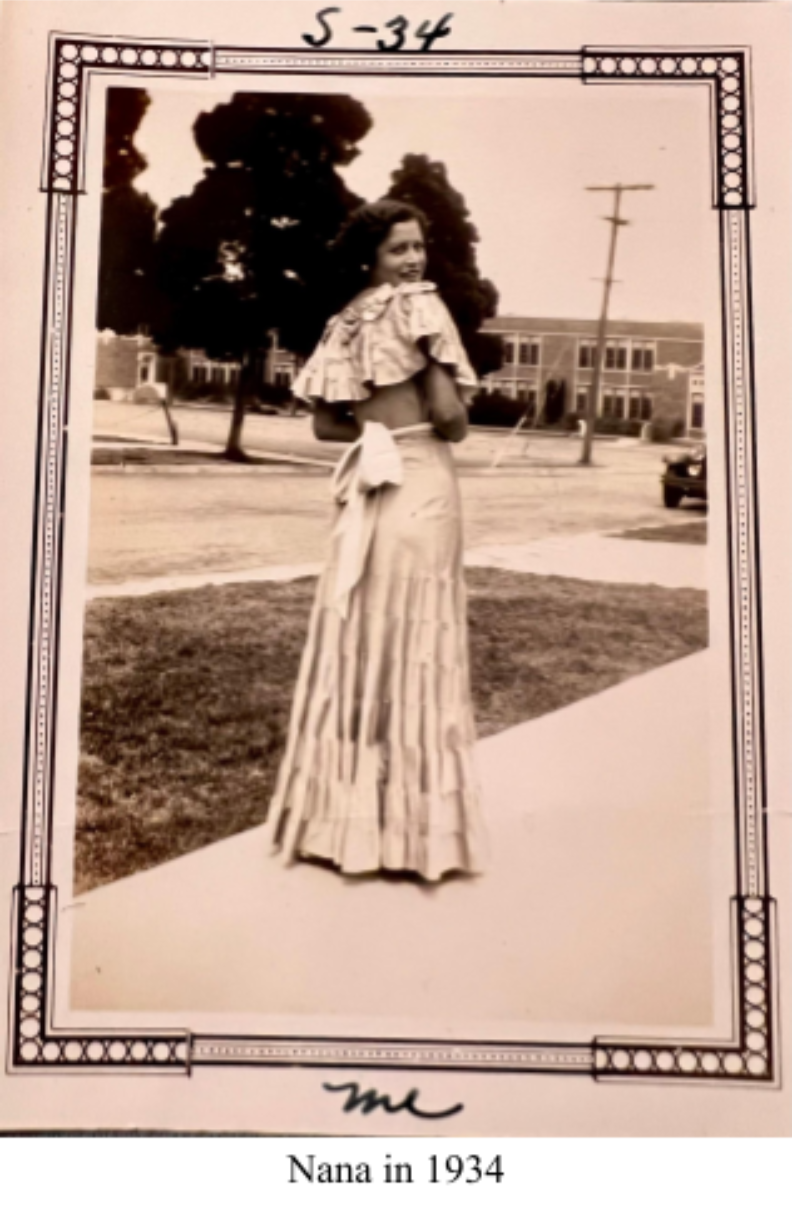
My Nana, my paternal great-grandmother was a gentle soul. Her name was Raquel Maria Padilla, and she was compassionate and always wanted to nourish and nurture those in her life; when you visited her, she would ask if you were hungry, assume the answer was yes, and prepare a meal for you. She was understanding, with the patience of a saint. She was also very private and did not discuss her feelings or her past even when questioned; my Aunt even remarks, “I didn’t feel like we could ask questions.” Even though Nana remained in my life until I turned nine, I rarely spent time with her but once a year due to the physical distance between us. These descriptions and my relationship with her mostly comes from conversations with her grandchildren: my father and aunt, and their description of her privacy rings true in my exploration of my genealogical roots. My great-grandmother was a Mexican woman who chose to conceal her identity and withhold mention of her childhood from those in her life– most of what I know about her life is after the birth of her grandchildren. I can only begin to imagine how my great-grandmother could resist mentions of her Mexican heritage, and her silence serve as sites of unresolved and eternal enigma. I am hesitant to interpret Nana’s relationship to her heritage, but generational discontinuities are defined through Nana’s choice not to pass on to her children the Spanish language that was the primary tongue spoken in her childhood home and that she used with her mother later in life; she chose not to impart her generational wealth of knowledge and history to future generations. Photographs, records, and recollections from those surviving ancestors offer partial and clouded accounts of the truth of our ancestry. When I think of my Nana, I can only imagine her likeness while I was alive. I feel embarrassed to mention that I never questioned whether photographs or stories existed of my Nana’s childhood, I assumed because I had not seen them, that they did not exist.
I lost my grandmothers and my maternal grandfather by the time I turned four, and the vast expanse of the continental United States stretched and separated me from my remaining grandfather –North Carolina to California– until his passing when I was twelve. The loss of my grandparents represents a discontinuity of generations of people whose blood runs into my own, whose faces resemble mine, and whose choices have more of an influence on my life than I will ever comprehend. I feel profound grief over the loss of desired intimacy between grandparents and grandchild; I am jealous of my parents who harbor, even in its complicated nature, an understanding of significant people in my own life who I will never know myself. My own relationship with my grandparents is experienced through the memories others share and through my own invention of intimacy imagined in the idealized archetypal role. How will I be capable of answering the questions posed by my own children about who came before them, how could I begin to describe my paternal grandmother when my own memory of her is simply encapsulated in light filtering onto a carpeted rug, the offer of boxed raisins, and chasing her dog around a hallway with cabinets of figurines?
I feel a frantic need to record stories and memories for my descendants who, because of the generation gap caused by my grandparents’ passing and my family’s lack of expressed curiosity and investigation, will not be able to answer many of the questions I myself am asking. I am undergoing a process of remembering in the sense that Bell Hooks defines the act: “The word remember (re-member) evokes the coming together of severed parts, fragments becoming a whole.(2003, pg. 394)” Each story, record, and photograph are severed parts in that they are detached from their contextual important and can only impart meager details about the figures they portray. There is also the aspect of re-membering my own construction of self, in that my understanding of myself: who I am and where I am today, is rooted in my understanding of those who came before me. As Jarvis expresses it, “those who tell such stories are led to actively explore their identities and through so doing, may find increased psychic coherence; those who listen begin to realize that their story did not start from a blank slate at the beginning of their own life, and may become inspired by ancestors who have shown courage, particularly if they have survived against steep odds. (2021, pg. 81)”
My paternal great-grandmother, who I know as Nana and her grandchildren call Grandma, was named Raquel Maria Padilla and had both the surnames of Gabelich and Fullen through marriage. She had two children from her first marriage: Gary Gabelich, and my grandmother Judy Lyn Gabelich, and three grandchildren whom she adored. While in San Pedro, California, Nana lived with her mother and brother in a house where the whole block was their relatives: Nana’s aunts, uncles, cousins, and possibly her grandparents. Through conversations with my family, I understand that Nana married her first husband, Michael [Mehl] Gabelich, immediately after graduating from high school at the age of 19, possibly in order to escape the stifling environment of her childhood. My aunt reminisces about a diary entry she read that spoke to how Nana wasn’t allowed to go on dates: “he [Mehl] was allowed to come over, and they could play cards on the front porch, but she wasn’t allowed to go out on a date, because Grandma Sanchez was that strict: you’re not going out if you’re not married”. At some point in time, Nana divorced Mehl and later remarried Paul [Grand Paul] Fullen who was her life partner even after their divorce in 1973. Given his central role in her life, I find it important to note the vivacity of Grand Paul; everyone described him as the life of the party, a jokester, and someone who" had a zest for life", but he was also an alcoholic– he would drink too much with Nana and was prone to volatile arguments.
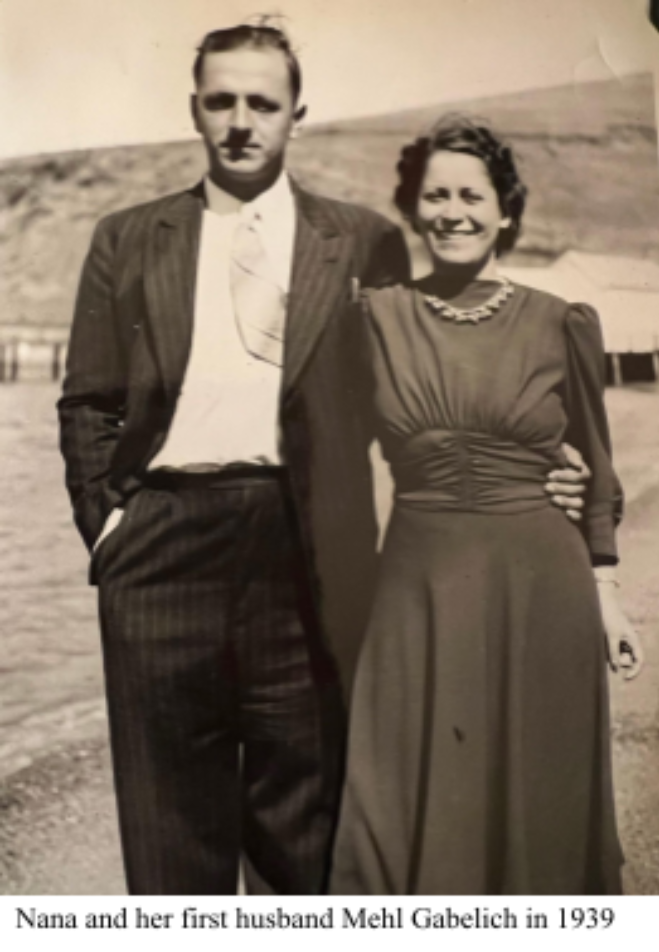
It is important to analyze the historical context of Nana’s life. I cannot say with certainty when she arrived in California but I am able to surmise that she attended San Pedro High School which places her there at the latest in 1935. The Mexican Revolution which began in 1910 and ended in 1917 –the year of Nana’s birth– motivated an increase in immigration to the United States. (CA Office of Historic Preservation, 2015) According to the California Office of Historic Preservation, “[d]espite changes to U.S. immigration policies in 1917, 1921, and again in 1924, the U.S. Mexican border remained relatively porous and the demand for labor in the U.S. fueled Mexican immigration.(ibid., pg. 1)” The dramatic influx of immigrants to the United States[1], paired with the economic hardship of the Great Depression, led to public scapegoating of Mexicans, regardless of citizenship, because of a public perception that they were unwelcome competitors for job opportunities and welfare programs. (ibid.) Considering the anti-Mexican sentiment at the time, it is conceivable to infer that Nana chose to assume a white identity because of her light skin, and the freedom it offered; my aunt imagined “she felt more respected as a white woman than as a Mexican.”
The online genealogy company Ancestry has begun to satisfy my ravenous desire to connect and learn about those who came before me, particularly in bridging discontinuities created by death, abuse, geographic distance, secrecy, and denial– as in the case with Nana. I feel deeply curious and joyful to discover the smallest detail about my ancestry: a name, a location, a profession, handwriting, and particularly stories. Patricia Hollands, in Sweet It is to Scan, remarks that “The peculiar fascination of personal photographs comes from this contrast between an almost unbearable richness of potential meaning and the inconsequentially and triviality of the medium. (1996, pg. 155)” Objectively, such details speak little to whom these people were as individuals, but for me, they are evidence of my connection to the throngs of unfamiliar faces, some of whom share these ancient ancestral connections. Through Ancestry, I discovered a birth certificate for my great-grandmother that showed her birth in Bisbee Arizona to Mexican parents: Camerina Maria and Salvador Padilla. This information is further complicated by the existence of a border crossing record for her name three years after her birth, though this document fails to account for the whereabouts of her parents or brother, who was born two years earlier. Salvador Padilla, her father is absent from any records of Nana’s life after her birth certificate, but Camerina is mentioned to be a widow in 1923 when she crosses the US-Mexican border in 1923 with her children and, contradictory to this fact, a Salvador Padilla of the correct age and birthplace is noted in 1930 census of Mexico. Such details are exciting because of the questions they answer, but their contradictory and partial state is a site of deep frustration, and I grieve the grasp on my Nana’s past that I likely will never be able to attain. Further, it is because of these inconsistencies within documentation and historical tendencies that invite the question of the validity of my ancestors’ citizenship, suggesting that they could have crossed the United States-Mexican border illegally. Such a perspective invited investigation into the influence of a fabricated and unstable reality.
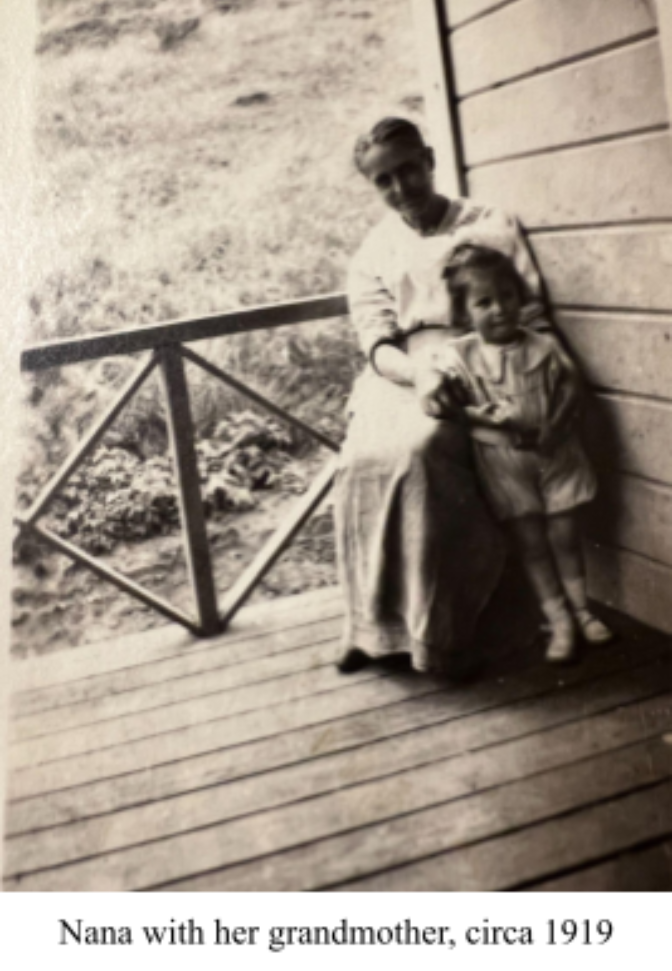
Photographs are only capable of conveying a partial reality and the vast majority of lived experiences are not captured by the lens. In John Szarkowski’s exploration of photographic framing, he notes that “the central act of photography, the act of choosing and eliminating, forces a concentration on the picture edge—the line that separates in from out—and on the shapes that are created by it. (1966)” This analysis emphasizes the nature of photographs as out of space, without relation, ungrounded in that they capture immense detail of the features within the frame but cannot account for contextual features such as the setting, motivation for the photograph, and any figures outside of the frame. An analysis of framing is incomplete without acknowledging the role of the unnamable photographer who demarcated what would be immortalized; who separated the known from the unknown. The photo to the left is distinctly meaningful because it represents Nana at an age where I cannot determine what country she is in; I desire to shift the camera –change the frame– and catch a glimpse of the house despite knowing that I cannot ever truly know who’s porch she is on, who is behind the camera, and most important to me, the complexity of her intrapersonal connection with her grandmother, the other figure in the photograph.
Heritage is understood as inheritable from generation to generation but Nana’s decision to separate herself from her past and not share her language and stories with her descendants represents a discontinuity; None of her descendants can speak her tongue nor have a knowing connection to Mexico. In collecting and defining my relationship with Nana as well as her Mexican heritage, I have questioned to what extent her past informs my present, particularly due to the disconnect caused by Nana’s silence. Nana was not unique in that she decided to deny her Mexican heritage as many light-skinned individuals choose to avoid racialization in order to access the privilege often associated therein. Therefore, while Nana did not impart a culturally Mexican identity, her descendants share a common Mexican experience of lacking a connection to their Mexican heritage. My dad, who is a quarter Mexican, noted that he could have ticked the Latinx box when present on surveys, but the idea of doing so “always felt odd because I felt so white, you know I looked white, my family seemed white, it felt like I would be lying to say I was Mexican, like I was taking advantage of the system.” I feel a similar detachment from a Mexican heritage, compounded by my not personally knowing my grandmother or Nana. Does my Nana’s denial of her Mexican heritage signify a complete breakage of her past and my present?
Am I disrespecting Nana’s wish for her descendants to know of her childhood or would she welcome, enjoy, or be grateful for my interest in her life? My aunt recounts visiting Nana in the process of helping her move and learning that she had ripped apart a diary and my aunt expressed that it killed her because it was something that she would have loved to hold onto. I feel similarly because a diary often contains the most intimate details of one’s life. There is an intentionality in this act of destruction because not only is Nana refusing to speak of her past during her lifetime, but she is denying future generations to learn about her past through stories that could be left behind. It invites me to question more fervently her intentions in concealing such details but also whether it is just for me to investigate her history when she was not open to doing so during her life.
References
California Office of Historic Preservation. (2015). Latinos in twentieth century California: National register of historic places context statement. California State Parks. https://ohp.parks.ca.gov/pages/1054/files/latinosmpdf_illustrated.pdf
Holland, P. (1996). ‘Sweet it is to scan…’ Personal photographs and popular photography. In L. Wells (Ed.), Photography: A critical introduction (6th ed., pp. 150-264). Routledge.
Hooks, B. (2003). In Our Glory Photography and Black Life. In L. Wells (Ed.), The photography reader: History and theory (pp. 387-394). Routledge. https://archive.org/details/photographyreade0000unse/page/n9/mode/2up
Jarvis, P. (2021). Ancestral Selfies and Historical Traumas: Who Do You Feel You Are? How Ancestor Research Affects Self-Understanding and Well-Being: Introduction to the Special Issue, 81-90. https://www.mdpi.com/2313-5778/6/1/20
Szarkowski, J. (1966). Introduction to ‘The Photographer’s Eye’. In The photographer’s eye (pp. 97-103). https://photobyrne.wordpress.com/2013/07/08/reading-john-szarkowskis-intro-to-the-photographers-eye-5-things/
[1] “Illustrating the dramatic increase in immigration in the 1900s and 1910s, the estimated Mexican population in California quadrupled from 8,086 in 1900 to 33,694 in 1910, and then increased by two and a half times to 88,881 in 1920.” (CA Office of Historic Preservation, 2015, pg. 4)